When I was growing up we had a house cleaner called Slava who was from somewhere just east of The Adriatic Sea. On meeting her, it became apparent why tension in her homeland prior to WWI gave rise to the term “The Balkan Powder Keg” - you suspected Slava might explode at any moment. Luckily for us, most of her angst was directed at her unemployed, nicotine addicted, alcoholic husband; whom she bagged relentlessly whilst providing a very satisfactory cleaning service - a cleaning service seemingly unavailable today.
Another part of Slava's service was an intimate description of her dental problems - right down to the part where they tore out her teeth, sliced open the gums, and re-inserted new ones. But at least - as the blood poured from her mouth - she continued to work. She was happy to wash up a few dishes (in a household of four children) if they were still in the sink when she arrived at . She then spent several hours vigorously scrubbing away her pain.
Things are different now. I was hoping to make fresh pasta today, but had to postpone this, as my cleaners just turn up whenever they feel like it. When they do eventually arrive, and in spite of limited English, they are excellent at communicating their wants - which essentially boil down to “move those piles of shit and get the hell out of here.” Everything must be perfect for their invasion.
Today, I kept the house in its once-weekly pristine condition for what we'd agreed would be a morning arrival. Instead the cleaners dropped by late in the afternoon, just before I had to collect the girls from school. If I was snowed under by several tonnes of flour, they would simply turn around and leave, so I dared not break out any ingredients or cooking implements. So I resorted to something easy to clean up, an impromptu lunch of smoked salmon, poached eggs, and spinach leaves plucked from the garden.
Fortunately fortified by my high-protein lunch, the cleaners, when they did arrive, ejected me from my house in a manner that would make a bouncer at The Ivy nightclub blush. From my exiled position, I deduced the three invaders were carrying one vacuum, one mop and one rag. After thirty minutes they evacuated.
When I engaged the current cleaning brigade I didn’t expect they’d be reorganising my cooking schedule, and nor did I expect to be unwittingly colluding in a grand Sino Ponzi cleaning scheme. The scheme works like this: when you start out with the new cleaners you initially engage with a person who turns out to be The Grand Master (GM). Initial negotiations will be conducted with The GM. The GM will turn up for a couple of weeks and help with the “cleaning” - despite the physical burden of an enormous new Rolex. After some time, the GM disappears and you will be given the telephone number of someone you vaguely identify as one of the assailants who descends on your house each week. This person is Number Two. You must then communicate directly with Number Two, and only resume contact with The GM in emergencies.
Time elapses, and one day Number Two will arrive with a Seiko, and before you know it there's a distinctive flash of a Tag Heuer. This means Number Two’s on the way up, and will shortly evaporate from your life; to be replaced by another person brandishing a copy of their PRC passport to give you comfort they are a suitable custodian of your house key. This person is Number Three - so on and so forth.......
With a profitable business this complex, there’s very little time for either punctuality or cleaning, which means all my plans get blown out of the water and the house merely receives a cursory wipe by three people I no longer recognise. Thank goodness Slava’s husband was too busy sucking at the teat of his wine cask to devise such a dastardly scheme - which meant our house was actually clean when she left. At least my impromptu poached eggs were perfect.
PS See below for how to cook a poached egg - without all the fuss of vinegar, glad wrap, ramekins and a whirlpool.
1) Ideally remove your egg at least 10 minutes prior to cooking so it is about room-temperature.
2) Pour water into a saucepan to 10cm depth and bring to the boil.
3) Once boiling, turn the temperature to low, then wait for the vigorous bubbles to dissipate.
4) Carefully crack in the egg. For a runny egg it will be ready after two and a half to three minutes - depending on egg size, egg temperature and general climatic vagaries.
5) After two and a half minutes use a flat slotted spatula and gently move it under the egg and raise it out of the water to check its progress. (Do not use a round, concave slotted spoon as the yolk will be inclined to collapse through its centre.)
6) The egg is ready as soon as all the white is cooked (ie no visible and wobbling gelatinous white). Allow water to drip off before gently sliding onto your toast.
Conquerors rarely opt for the worst digs in town after they’ve finished the business of invading. When the Germans rolled into Paris in June 1940, they didn't move into the deserted slums of the city, but instead the eighteenth century building on 228 Rue de Rivoli which housed – and still does - Hotel Le Meurice.
This is the sort of endorsement you simply can’t pay for. We all know Dictators just love grandeur, and it speaks volumes about the place. Today, it’s all the more fabulous thanks to its recent restoration and the fact it's now Gestapo-free. (Although management don't seem too particular about guests’ Human Rights credentials, as the sons of Dictatorial villain du jour Muammar Gadaffi recently shacked up there for several weeks.)
Le Meurice doesn't only welcome homicidal dictators. In fact, the 3 Star Michelin Restaurant le Meurice within the hotel is the only restaurant on earth where I’ve walked in and been greeted by name. And I don’t mean after we’d gone through the pleasantries, I mean as I actually walked in. This also impressed my wife-to-be, until it dawned on her this was the by-product of my afternoon reconnaissance to ensure all was in order for our impending visit. But, at least the maître d’hôtel had remembered me - in one of only four hotels in Paris granted palace status by the French government.
Having earlier farewelled the girls and our babysitter (whom I procured over the internet….) at our apartment on the Ile de la Cité, the short taxi ride had us arrive at the embarrassingly early time of .After my ego-boosting greeting, we were escorted through the hotel foyer and into the dining room where there are only about fourteen tables spaced over several acres.And yet, the room is even higher than it is wide. The entrancing opulence of the Philippe Starck restored interior (inspired by the Salon de la Paix at the Château de Versailles) is quite breathtaking, with its chandeliers, gilded mirrors, several mints worth of gold on the walls and ceilings, enormous artworks, and floor-to-ceiling windows facing the Tuileries gardens.
Once seated, we had pleasant chats with the mostly English-speaking French staff about our origins and travel plans. A few gags were thrown in which lightened everyone up, and the waiter offered to photograph us before the culinary onslaught commenced. A small Hermès stool - which appeared tailored to provide a resting place for a poodle - was brought to the foot of my chair to house accoutrements such as handbags and notebooks which threatened to destroy the aesthetics of the table setting.
Menus in both French and English (offered without the slightest whiff of condescension) presented the option of à la carte, degustation, or a combination of both. Knowing the sommelier and chef would be better equipped than us to generate a superior combination (there are 1100 different wines in a cellar of 30,000 bottles), we ran with the eight course degustation and matching wines.
Having announced our decision, house-made butter (lurking beneath Le Meurice-emblazoned wax paper) was unveiled with a flick of miniature silver tongs, and accompanied by a choice of three different types of rolls. This was like a quick warm up for the staff. Every one of the main eight courses which rolled out over the next four hours was ferried to the table on a large silver tray supporting two cloche-covered plates. Each plate was placed simultaneously on the table by a different waiter. Each retained a hand on the cloche as their superior stood by and described the lineage of what we were about to eat, before the waiters theatrically revealed the contents at the precise moment the story concluded.
The genius behind the food appeared before our meal started, and he toured the room, greeting every table. Chef Yannick Alléno is a bit of a rock star in France, and is annoyingly handsome. If he ran off with your wife after the coffee was served, you’d be left shrugging your shoulders without any great degree of surprise. He was granted 3 Michelin Stars four years ago aged just 39. His team of more than seventy staff work predominantly with classic French ingredients and techniques, but combine them with modern flavour twists, methods and presentation. He came back a bit later and kissed a lot of people, but inexplicably by-passed our table.
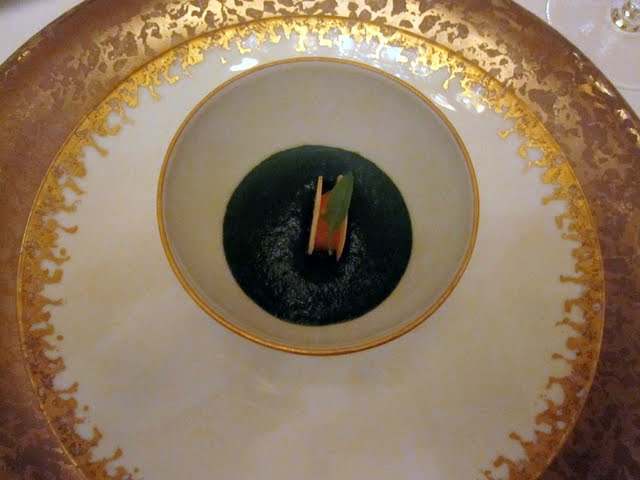
While his food is particularly “French”, and despite spending his career almost entirely in French kitchens, the maitre de explained he has been influenced by Japanese colleagues and this was evident in our first course, Delicate Jelly of Turnip Broth with Yuzu - yuzu being a small, distant relative of the mandarin, used in Japanese cooking to impart its unique citrus flavour, and as a base for teas and preserves. This jelly “broth” was served with seabass tartar and scattered with clippings of iodized seaweed. This first course arrived after a complimentary amuse-bouche of salmon mousse under a canopy of spinach puree, embedded with a mouthful of fresh salmon in a miniscule wafer sandwich.
The next dish displayed a simple use of new-in-season ingredients (it was autumn). Chanterelle Mushrooms with Vin Jaune was exquisite and unimaginable to anyone whose experience of mushrooms extends no further than the button variety. These gorgeous fungi were cooked in little more than butter and parsley, and served with a superb salad leaf stuffed with pork fat, Swiss chard and veal juice. Unfortunately I was so enamoured with the dish I forgot to photograph it.
The hint of delightful richness nestled in the salad leaf was brought to a crescendo in the subsequent course, Roasted Duck Foie Gras, served with mango juice and spiced thin biscuits. Four plump wedges of perfectly cooked, rosy foie gras, adorned a plate punctuated with half a dozen tiny mango balls crowned with micro-coriander, nestling in puddles of mango juice. The wafer thin, ginger and clove-flavoured biscuits, helped the fruit lance the liver’s wonderful fatty richness. My dining partner found the intensity too much to defeat. I did not.
The fish following the foie gras was my favourite dish of the evening. A superbly cooked Fillet of Turbot Braised with Thinly Sliced Parisian Mushrooms in a juice of soup herbs, was simply delightful. A magnificent piece of this firm-fleshed fish was enhanced by the most exquisite herb, butter and wine sauce (which the head waiter happily delivered more of in a beautiful silver saucepan, and confessed to an afternoon of consuming several helpings of the sauce with nothing but bread).
The next course presented the only choice to be made from the degustation menu. Demonstrating the chef’s capacity to adroitly merge the traditional and the contemporary, Scottish Grouse with Aged Malt was presented in a most unlikely rectangular slab, with layers of grouse leg and foie gras cooked sous vide, while the Larded Fillet of Beef Marinated with a Seaweed Jam (accompanied by braised vegetable compressions and polenta balls stuffed with fresh cream) was cooked to perfection; but not by sous vide as is often the case now with such cuts. We opted for both and shared. The flavours and textures of the grouse were intense and terrine-like. This was accompanied by buttered rat potatoes, a masterstroke in which this fingerling, heirloom variety (La Ratte) was presented in silky pureed form, with tiny, crunchy, round, potato-crisp type pieces layered on top like dinosaur scales.
Above: Scottish Grouse served with Buttered Rat Potatoes
Above Larded Fillet of Beef Marinated with a Seaweed Jam
A cleanser of Tomato and Mozzarella with Basil was served after the meat course, and consisted of three miniature pouches of mozzarella balls topped with tiny fresh basil leaves. The balls disgorged liquid mozzarella onto a plate dotted with basil oil and discs of tomato jelly.
The tomato dish seemed designed as a sort of cleansing anti-venom to what we’d eaten, and what was to come – which was two pre-desserts, prior to the two desserts proper. At this point a stroll was in order.
The most acute manifestation of the staff’s intuition is evident at the time one is required to attend to one’s lavatory. That first faint crackle of a signal from bladder to cerebral cortex seems to be hot wired to a small bell, in wherever it is the waiters mingle to recuperate in between service. The split second one commences a flexing of thigh, to launch the derriere from it’s station, a phalanx of waiters immediately assemble at the rear, ensuring the diner never has to undertake the unpleasant task of propelling the chair backwards unassisted.
One waiter is then empowered with the role of toilet guide. Simultaneously majestic and subservient, I followed while a path was cleared by my gesticulating overseer – through the dining room, out past the hotel’s “other” restaurant, past the guitarist in the bar, down the corridor before being delivered into the bathroom’s welcoming embrace. Surprisingly, the facility was free of staff.
I felt relieved I’d been empowered to navigate the return journey unassisted, as I was slightly disappointed with the performance of my new shoes I’d purchased in London. Specifically, their cheap rubber soles did not create what I deemed an appropriate cacophonic accompaniment to their majestic surroundings. I’d been able to mask this inadequacy on the outward journey by veering towards carpeted areas, but whenever I deviated too dramatically from the wake of my leader, a quick turn of his head pulled me back into line. Each time I squeaked onto hard ground (polished marble I think), I felt as if the room collectively observed and derided the absence of leather on my soles. Our proximity to the restaurant’s entrance fortunately kept this a secret from my fellow diners as I scurried back to our table.
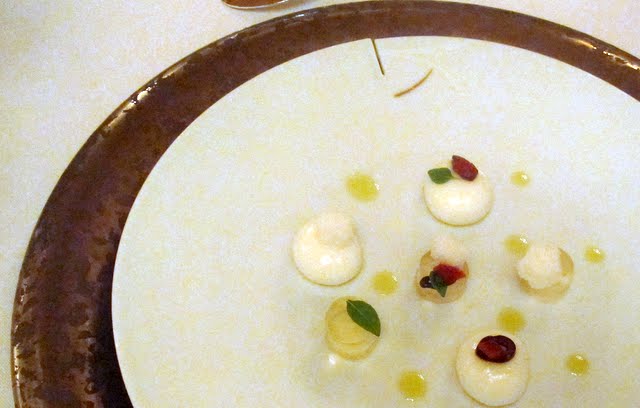
Mercifully, the first pre-dessert was designed to cleanse, and a bowl of fresh figs in light syrup with gold leaf garnish, was accompanied by another bowl of pink grapefruit in a fairly neutral citrus foam. This led into a daunting array of petit fours which we simply couldn’t conquer whilst burdened with the expectation of the ensuing two actual desserts.
The first, was a lovely simple serving of Roasted Pear Hearts with Caramel and Liquorice accompanied by a light vanilla chiboust cream and crunchy “arlette” biscuits wedged like sails in the cream. This was served with a Hungarian Tokaji, not something I would ever have chosen, proving why it’s worth putting yourself in the hands of a great sommelier.
The final dish was a masterpiece in appearance, texture and taste. Warm Soft Chocolate Mousse Cake with bourbon vanilla ice cream, was a rectangular offering no bigger than a playing card, built about half a centimetre high from thin chocolate cake encasing an epicentre of soft chocolate mousse. On top, a wafer thin, crunchy, gold leaf-decorated toffee roof supported the ice cream.
As the clock approached midnight there was time for a quick brandy and a €12 cup of coffee to aide the digestion - which I needed when I received the bill, as it came in at just shy of €1000, or about $1600 AUD. Plus tip.
Footwear aberrations and slight budget blow out aside, it was impossible to fault the experience. We ate majestically and were looked after as well as even the most ruthless Dictator could hope to be. We arrived home to find our children bore no visible scars from an evening with the web-sourced babysitter, and I fell asleep, not with the bitterness of a $20 cup of coffee in my mouth, but the sweetness of twelve perfect courses and a $1600 bill. I hope to go again.
I’ve recently been burdened with a need to put bread back on the agenda. Bread baking, that is. It’s been far too long in between loaves, and whilst I’m not imagining for a second that I will now bake daily, I’m at least $7 ahead thanks to yesterday's effort.
My dissertation on commodity prices a couple of weeks ago (Rich Farmers The New Stockbrokers) supports my underlying thesis of today - decent bread costs shit loads. And I do love decent bread. My Sydney-centric favourite go-to loaves, in descending order, appear something like this: Bourke Street Bakery Plain Sourdough, Bourke St Bakery Rye & Caraway Sourdough, Sonoma Soy and Quinoa (the only state in which I find quinoa digestible), Sonoma Soy Linseed, and for versatility and all round popularity in our house, The Rozelle Bakery Wholemeal Sourdough which produces flawless toast, and retains sufficient moisture to make it into the lunch box the following day.
I do like the Infinity Baguette, but my nearest available outlet is Norton St Grocer and if I go in for a loaf of bread, I know I’ll spend so much on other delectables, I’ll emerge with a BBB minus credit rating.
Imagine for a minute I bought one of these loaves each day (which I don’t, as I generally retain them until they resemble an attractive new product line for Boral Building Supplies, then toast them). But if I did - depending on the point of procurement and the particular product mix - my bank balance after 7 days would be around $45-55 worse off. That’s $2500 a year, or about 25% greater than an around-the-world airline ticket.
This was not the main reason I baked a loaf yesterday, but it does mean I’m $7 richer today. I phoned my sister to enquire whether she’d baked of late, and if so, which recipe she used. It turned out she had baked, and the recipe she used, was in fact my own; which I seem to have lost in my records - somewhere underneath my collection of handwritten letters from 1994, year 8 history books, my Sturt mini-league certificate, and family artefacts including my Grandfather’s boarding school tie box which I recently dated to 1916.
I took down my recipe she recited, and then made some minor tweaks. I set to work and Olivia assisted with the "heavy lifting". I’m extremely happy with the result, but intend to put this loaf up on blocks and tinker with the mechanics as I feel I can extract an even superior performance from future incarnations.
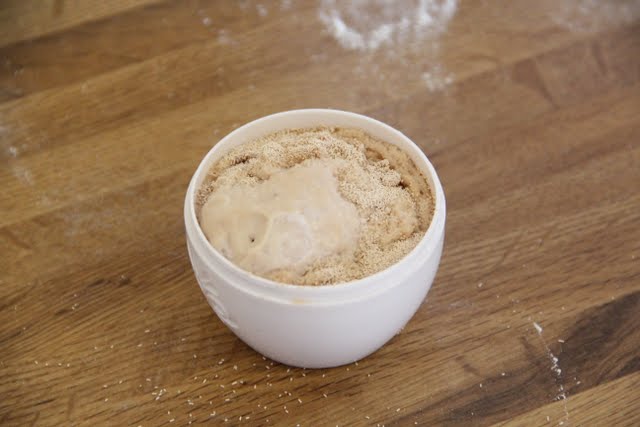
I’m not harbouring a yeast culture on the premises at the minute, so relied on dried yeast. Otherwise, it is a bit of a purists loaf in that it doesn’t include any jazzy stuff like oil or sugar. Follow it to a tee, and you will find it is simple to make, produces a clean and satisfying bread experience, will bolster your credit rating in these turbulent times, and provides a marvellous platform for a coating of butter.
Ingredients:
3 cups double zero or plain unbleached flour
1 cup wholemeal flour
2 x 7g yeast sachets and 1/3 cup of lukewarm water
2 teaspoons salt
1 cup lukewarm water
1)Dissolve all yeast in 1/3 of a cup of lukewarm water. Put both flours and the salt into a large mixing bowl and combine.
2) Create a well in the center of the flour. When the yeast has started bubbling and the granules appear dissolved, pour the mixture into the well. Slowly stir the yeast mixture with the fingers of one hand to progressively bring the flour into the mixture, then gradually add the 1 cup of lukewarm water to make a dough. You may need to add more water if it feels too dry.
3)Once you have a mass of dough (it may still be scrappy), tip it onto a lightly floured bench and get kneading. Knead dough for ten minutes until lovely and elastic. You must do the full ten minutes, and this also negates any need for dips in the gymnasium this week. Great tricep workout.
4)Turn the oven on to create a warm place on the stove top. Put the kneaded dough back into the bowl and cover with a tea towel dampened with warm water. Place bowl in warm place on or near the oven. Once your loaf has doubled in size (approx 50 mins), remove from the bowl, place on bench, punch the air out of it and knead again for 5-10 minutes.
5)Place into a lightly greased bread tin or baking tray and fashion to your desired loaf shape. Lightly score with a sharp knife and brush the loaf’s top with a little milk. Cover again with a tea towel and leave in your warm spot and allow to double again (approximately 25 minutes, but will vary).
6)Preheat the oven to 225C and once the loaf has doubled in size, gently place it in the oven, ensuring you don’t bump any air out of it. Try not to smash the door closed. After 10 minutes, carefully open the oven and place a tray with warm water, below or next to the loaf. Bake for a further 10-15 minutes. When cooked, the crust on the bottom will feel firm and the loaf will make a hollow sound when tapped with a knife. Allow to cool on a wire rack for 30 minutes.
I’m told that until very recently, the ovine division of the CSIRO was focused on a top secret project designed to clone a sheep-like organism with numerous legs propelled by a minimum cluster of functioning organs. The historical demand for just legs was such that the industry’s marketing wing determined all other bits of the sheep were ostensibly obsolete.
As anyone over the age of about thirty four is fond of recalling, lamb shanks used to be thrown to the dogs. And despite a brief flirtation with a crumbed and fried brain, there’s been little culinary demand for the other bits of sheep excluding numerous interpretations of the lamb chop. And then at some point in the last decade, the previously neglected lamb shoulder emerged from the mist-shrouded recipe swamplands.
It seems the shoulder was previously only rarely cooked with bone-in and snuggled beneath its blanket of fat. It was usually boned and rolled, or bundled up in various forequarter contortions. In my childhood and most of my youth, I certainly only ever recall exposure to the leg.
Page 60 of my 1977 edition of The Australian Women’s Weekly Original Cookbook (first published 1970) alphabetises twenty seven different cuts of lamb, including saddle, shank, side, and stewing chops, but contains no reference to ‘shoulder’. My CWA (NSW) Cook Book has twenty one lamb recipes (including Lamb Cutlets & Spaghetti) but only one (Shoulder of Mutton with Kidney Stuffing), specifically identifies the shoulder as a food source. Then, someone (re)awoke to how much flavour bones add, how good fat tastes, and the amazing benefit of slow cooking.
I can’t precisely recall when the shoulder first lumbered into my kitchen, but I’m confident it was post-millennium. The shoulder is the front bit of the sheep at the top of the fore-legs and under the neck, while the leg you eat so often comes from the two rear appendages. Some older lamb "roast" recipes I did locate, suggested using either shoulder or leg. This strategy seems plain wrong, as the two are so markedly different in fat content, amount of bone, and muscle fibre variation. Surely they should be treated quite differently.
Now it seems we’re loving flaps, breasts, ribs and belly. In these bits and pieces the flavour's even more concentrated thanks to the ratio of bone and fat to meat. One of the most memorable things I've eaten this year was a quivering lamb belly at my sister's 40th at The Stokehouse in St Kilda; as were the succulent lamb ribs marinated in beer and miso I recently sucked from the bone at Gardels Bar in Surry Hills.
This chef-led descent into a region of the carcass identified by Meat & Livestock Australia as “Party Ribs”, is causing my palate to celebrate, but it is less than encouraging for those of us with cholesterol readings higher than Don Bradman’s batting average. And then, this crucial piece of data from the Journal of Nutrition landed in my inbox. According to an investigation by Sheila West of Penn State University, adding spices including turmeric and cinnamon to a “high-fat meal” can reduce triglyceride response (ie bad cholesterol) by nearly 30% relative to the same meal without the spices.
While less than impressed with Sheila's sample size (six overweight men), and the fact her research was bankrolled by The McCormick Science Institute (ie. the S&P listed $US6.5 billion McCormick spice people.....), I nonetheless dropped everything and went directly to a festering corner kitchen cupboard, which for the purposes of this story, I’ll call a ‘pantry’. Elbowing aside the baked bean tins and mountains of oats, I pinned down a spice-filled Tupperware container I’m now certain houses all the medicine I require for a healthy heart and long life. Olivia and I then jumped in the car, and after one disturbing report from a butcher that he “wouldn’t have any until Thursday”, we located a fine lamb shoulder specimen at Wareemba Meats, on Great North Rd Five Dock.
With Olivia's help, I set about lowering my cholesterol with the following recipe:
Ingredients:
1 Lamb Shoulder including shank – approx 2 kg (have butcher cut into 2 pieces to fit in pot)
½ cup plain flour
1 tablespoon salt
1 teaspoon pepper
2 tablespoons olive oil
2 carrots, diced
2 stalks of celery, diced
1 brown onion, diced
4 whole peeled garlic cloves, bruised on a chopping board with a flattened knife
1 cup dry white wine
1 tin of cherry tomatoes
3 fresh bay leaves (or 2 dried ones)
2 strips from an orange (use a potato peeler and avoid too much of the “white”)
1 pinch of saffron (15-20 threads)
1 cinnamon stick (or 1 teaspoon cinnamon powder)
1 teaspoon sugar
1 teaspoon balsamic vinegar
1) Pour 1 cup of boiling water over saffron threads and cover with cling film. (This must be done first to allow the saffron to steep whilst preparing the rest).
2) Pre-heat oven to 120C and place orange peel in the oven for 5 minutes until dehydrated. Remove orange peel and increase oven to 150C.
3) Tip flour, salt and pepper into a plastic bag (and cinnamon powder if not using a quill). Place this bag inside another, and then individually place each piece of shoulder into the bag and shake until lightly coated all over. Brush off any excess flour.
4) Heat pot over high heat. Add olive oil and brown both sides of the shoulder pieces in batches.
5) Turn down flame to low. Add more oil if absorbed by meat, tip in garlic and onion and cook gently for 3-4 minutes.
6) Increase heat to medium and add in celery and carrot and cook for further 5 minutes, stirring regularly.
7) Pour in the wine and deglaze for 1-2 minutes.
8) Add the meat back to the pot, then pour over the cherry tomatoes.
9) Add the bay leaves, dried orange peel, cinnamon stick and the saffron mixture. Pour more water into the cup to collect any remaining saffron colour and filaments and add this into the pot. There should be sufficient liquid to almost cover the meat. Add more water if required.
10 ) Bring to a gentle bubble, place a piece of foil over the meat and juice to prevent excessive moisture loss, secure the lid and place pot in the preheated oven at 150C for 2 to 2 1/2 hours.
11) Remove from the oven without disturbing the lid and allow to cool for 20-30 minutes to allow fat to rise to the surface.
12) Remove the lid and the foil and drape pieces of paper towel or tissue gently onto the surface of the liquid to absorb the fat, then discard. Continue until most fat appears absorbed.
13) Remove the meat from the bones using tongs and a knife, and shred or carve into desired-sized pieces. Remove any excess fat globules. Discard the bones and add the pieces of meat back into the pot.
14) Gently re-heat on the stove top and add the sugar, vinegar, salt, pepper. Adjust all according to taste.
15) Serve with anything capable of absorbing the magnificent juices, such as mash or cous cous. Accompany with greens and red wine.
This cholesterol-defeating recipe can be prepared the day before and placed in the fridge after the cooling step. Scoop the solidified fat from the surface and discard. Gently re-heat the remaining nice bits in the oven.The meat will slither from the bone when prodded with a spoon.
Do you have memories of much shoulder-eating last century, or was it all chops and roast leg? I’d be interested to get your comments. And many thanks to my Uncle Geoff for providing the magnificent image of his extremely fat lambs.
Before departing on one his jaunts, travel writer and food critic AA Gill likes to apply the blinkers and ignore what other people think about his next destination. This makes a lot of sense - especially when you’re AA and the blinkers concentrate his focus on the dashboard of his Rolls Royce, the rear of the First Class seat in front of him, or the stars of the porn film he once directed. But the recent SBS French Food Safari episode on Lyon, reminded me why his approach is right.
Unfortunately I travel less regularly than Adrian (his real moniker) so I’m a bit more selective in what I learn before heading off; so as to avoid picnicking on highways, camping in industrial estates or eating Bhutanese food, in say, France. But if I’d listened to most people, and the dreary indecisive babble of the guide books, I would never have visited Lyon - where I arrived not in a Rolls Royce, but a filthy campervan after a three week exploration of south western France with wife-to-be, our two children and an Irish speaking GPS. And the first magical thing about hitting Lyon, was that we rejoined the class of people who don’t shower in thongs. In a hotel.
The few non food-centric guide books I’d permitted myself to peruse whilst crunching around the region on the wrong side of the road in 5 metric tonnes of campervan, set my expectations extremely low. Persistent references to Lyon as an “industrial town” and “riots in the 70s” meant every person I saw who wasn’t throwing a Molotov cocktail came across as Catherine Deneuve, and each building which wasn’t a burning factory, appeared as a stunning historical relic. “Look at that gorgeous door. Why is it not in flames?” I'd ask myself.
More importantly, the women are more attractive on a per capita basis than anywhere else we visited in France, including Paris - although on a weekend, I suspect many come from there, covering the 400kms on the TGV in only 2 hours. Most are probably in Lyon to eat. Split by the Rhône and Saône rivers, the city has cobbled alleyways I didn't expect (not very industrial) and vast tracts of eye-catching people eating, drinking and smoking flat out, rather than igniting buildings. The central streets are full of beautiful shops and beautifully dressed people. If you live in Lyon there is simply no excuse for sartorial aberrations or poorly dressed children.
Food is an incredibly important part of life in Lyon, and I’m not talking about the oft-mentioned Paul Bocuse, whose presence here holds little relevance when shackled by two children on a short two day visit. In a cruel twist, we did not manage to get to the magnificent Les Halles market, but just walking the streets and looking in windows is a gastronomic powerpoint presentation. I longed to bang one of the above truffle-stuffed fowls into the oven.
The same shop sold these poached fish, snails and terrines, alongside meat and salads, an approach to food retailing completely non existent in Australia.
But of course the downside of staying in a hotel is that you can’t cook. So take heed, if you’re in the vicinity of Lyon and hoping to lose weight, then join the ring-road, drive right past the city and don’t stop until you reach Holland. The food here is rich. Just down the road in Provence we’d been eating figs, olives and delicately sliced, cured pig in every conceivable form - and then we hit Lyon. It felt like driving along a brand new piece of tarmac at 300km/hr and suddenly running into a pit of molasses. The food is slow and heavy. Flying out of Lyon after only two days had Ryan Air demanding I pay for excess flabbage. Fit, healthy and eating celery in Provence one minute, goitre-ridden in Lyon the next:
The two bouchons we ate at were the principle cause of my physical deterioration. The bouchon is an appellation-type concept designed to protect the integrity of traditional Lyonnaise food, with about 25 restaurants qualifying annually for the official designation Les Authentique Bouchons Lyonnais. The first evening we tried to get into the Café des Fédérations, which being a Friday, was of course booked out and we ended up in a touristy area at the Les Enfants Terribles. As always in these circumstances, it’s a stab in the dark but I’m a sucker for wooden panelling, and an otherwise full restaurant. Here, I was thrilled to be introduced to a gelatinous calves’ foot salad, followed by a liaison with a slightly disappointing sausage. But the room was convivial and didn’t just seem to be full or tourists like us. When my sausage flagged, I was able to help the girls out with their meagre offering from the kids' menu:
Because we were tourists it was required that the following day we ride the funicular up to the Cathédrale Saint-Jean-Baptiste de Lyon.My calorific overload demanded a stroll so we went directly to the gardens attached to the hillside and meandered through the drizzle, down the hill into the Vieux Lyon (the old bit) and upon the Les Ventres Jeaune (The Yellow Belly) bouchon, a recommendation from a Frenchly handsome barman the previous evening.
On a Saturday afternoon Les Ventres Jeaune was packed with what I liked to imagine were locals, all decimating towering carafes while ploughing through lentil salads, salad Lyonnaise, Bresse chicken, and a variety of internal organs.Despite having been funiculared up the hill, and rolling back down, I managed to convince myself I’d earned a three course lunch. The girls’ meal was a diabolical sort of frankfurter and fries, but I enjoyed my pike quenelles drowned in rich seafood sauce. The carafe of rosé was bad in a good way.
Mercifully for my health, we prepared to depart the following day, and then as if on cue, a sort of mob assembled in the expansive place Bellcour right out the front of our hotel in protest at some abomination from the government suggesting the French work a bit more. There was smoke – a fatal mingling of Gitanes and Gauloise - but no fire. And it may have been the mere thought of work, or the fatigue of protesting, but by they seemed to run out of puff and suddenly the cafes and bouchons were full, and we escaped to the airport with the most articulate and intelligent taxi driver I’ve ever encountered.